
Key takeaways
- An overlay (often called resurfacing) places new asphalt over existing pavement. Remove and replace takes failed asphalt out and rebuilds it.
- Overlays depend on a sound base. Failures underneath tend to show back through a new layer.
- Many projects combine the two: failed sections are removed and replaced, then the whole area is overlaid.
- Added height matters. Curbs, gutters, drainage, doorways and accessible routes still have to work afterward.
Two different fixes
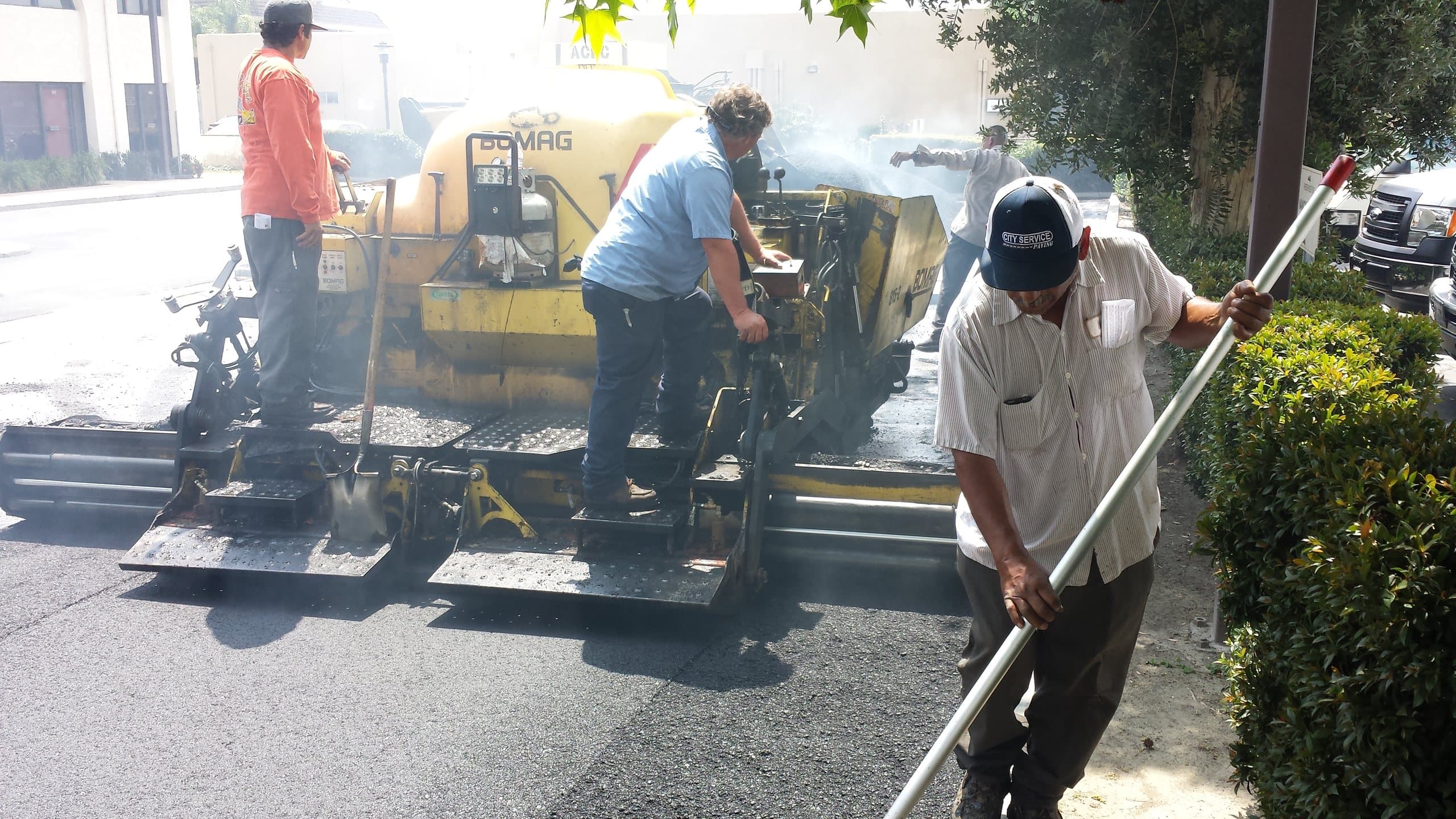
An asphalt overlay is a new layer of hot asphalt placed over existing pavement after it has been cleaned and repaired where needed. Edges along curbs, gutters and other fixed elevations are commonly ground down (milled) first so the new layer ties in flush. A paving fabric, such as Petromat, can be placed between the old and new asphalt as an interlayer.
Remove and replace means saw-cutting around failed areas, taking out the old asphalt — and unstable base material beneath it where necessary — then compacting and paving new asphalt. It can be a handful of patches or an entire lot.
When an overlay makes sense
- The base is stable: the pavement isn’t sinking, pumping water or breaking into pieces under traffic.
- Distress is mostly at the surface — weathering, raveling, or scattered cracks that can be filled.
- There is room to add height without creating drainage problems or trip edges at curbs, gutters, doorways and accessible routes.
- Water drains off the pavement, or drainage can be corrected by milling and reshaping the surface.
Timing matters. FHWA’s pavement preservation guidance notes that treatments such as crack sealing and slurry seals work well when done in a timely manner, before the structure is damaged. Waiting until the base fails can turn a resurfacing project into a reconstruction project.
When failed asphalt has to come out
- Alligator (fatigue) cracking: small, jagged, interconnected cracks that FHWA attributes to failure of the asphalt surface under repeated traffic loading, and which its slurry seal checklist associates with subgrade failure or inadequate drainage.
- Potholes that return in the same places after patching.
- Soft, sunken or rutted areas, or water coming up through cracks.
- Standing water that reshaping the surface can’t fix.
- No room to add height — for example, where an overlay would bury a curb face or block a gutter’s flow.
Overlaying these areas without repairing them lets the damage work back up through the new asphalt. That is why City Service Paving handles asphalt work from a simple pothole repair to a full remove and replace.
The common answer: both
On many commercial lots and community streets, most of the pavement is serviceable while some areas — entrances, truck routes, low spots — have failed. A common plan removes and replaces those sections, fills cracks, and then overlays the whole area for a uniform new surface. Concrete items such as curbs, gutters, swales and flowlines are often repaired in the same project so water leaves the pavement properly.
How to get a reliable recommendation
- Walk the property with the contractor and have failed areas marked on a site plan with approximate quantities.
- Ask why each area gets the treatment proposed: overlay, patch, or remove and replace.
- On large projects, or where base failure or drainage is suspected, consider core samples or a pavement evaluation by an engineer.
- Ask how the work will be phased so the property stays usable, and how residents, tenants and deliveries will be notified.
- Make sure restriping, and a check of accessible parking, are part of the scope.
Our team of estimators reviews each project and puts together a quote. Request an estimate, or read how often parking lots need maintenance.
Sources
- Pavement Preservation (Federal-aid Essentials for Local Public Agencies) (opens in a new tab) — Federal Highway Administration
- Distress Identification Manual for the Long-Term Pavement Performance Program — Glossary (opens in a new tab) — Federal Highway Administration
- Slurry Seal Application Checklist (Pavement Preservation Checklist Series) (opens in a new tab) — Federal Highway Administration